Friday, August 24, 2012

nothing but this


in the afternoon light i walk past the fractured greens that appear mirrored below the
dock. bleary pictures go unnoticed as charts and gas levels are checked, gear, food and
beer are stowed. the anticipation of spending hours offshore is wide and measurable.
tide fills and spills over eel grass and mud, driftwood, bent, broken, knows
no other path, only the urging of the sea. it'll pull you with it if you let it.

i will let it. even if i don't, it can't be stopped.

the glint, the way over repeating wavelets, where you go where
you want to go, dark, unseen, plunging straight and deep and sharp,
water purled in halves, fourths, eighths, sixteenths, a formula
that confronts what is known and leaves the unknown for who knows
who to dissect. will people always live in separate universes? will they always be

divided?

the wind grabs, the waves demand. before i know it, what was once

part of my world is lifted, toppled

blown into the sheen, murk, and mold of forgotten sneakers,
doorknobs, bottle caps, favorite hats, cellophane, wire, mesh, nylon
rope, fenders, bumpers, bud light cans, lampshades, pieces of rubbermaid,
shopping carts and baseball caps, all sunk, saturated, slurried
caught between this place and that. above

my head the ceiling of light is so bright i feel it will blind me
if i rise too quickly; bubbles, tiny fish, plankton float
away, up and up, cutting a swath of graceful motion
through the water. i cough, i sputter; my eyes sting.
now i've been there, now i know.

make a note in the book of restless days and salt:
what we call life is what we've come back from,
scathed, our eyes pried wide open,
unsighted no longer.


Monday, August 20, 2012

full throttle


on land or on sea, those two words may be used to describe how we might—if we choose—live our lives in maine, or elsewhere for that matter, where both the expected and the unexpected can pop up at any time. in maine we have bears, and we have pirates—oh yes we do—and we have lots of waves. i also have it on good outside authority that maine is an amazing place and that it stimulates all kinds of imaginings.

to some people—especially small visitors from the warm south—that's the good news. the bad news is that the summer air may feel a tad too cold (80 during the day, 60 at night—but just wait a few months!), and the sea may not be quite warm enough (66 degrees in the middle of casco bay in the middle of summer). oh well, you can't please everyone.

our gaggle of guests observed many wild beasts during their visit, beasts which presently live in maine, such as moose, bears, lynx, bobcats, foxes, coyotes, owls, and bald eagles, and those which once inhabited the state, such as mountain lions.

the animals were viewed—some "sitting pretty" with their eyes masked!—in their natural habitats in the large, forested maine wildlife park in gray. many of them are being rehabilitated, and hopefully will be able to return to the wild someday, and others are being relocated, having been rescued from precarious situations (raccoons stuck in chimneys, skunks slinking around under porches, bats inhabiting attics).

on another day a large population of pirates was spotted aboard a pirate ship. in particular, a pretty and very—argh, matey—tough pirate hung on for dear life in the wildly pitching crow's nest while attempting to hoist the skull and cross bones at the portland children's museum.

and then there are the people who can never get enough speed, and for whom "full throttle" is a somewhat meaningless concept because it merely states the obvious to them—they believe as much of life as possible should be lived at full throttle. i must say, i concur.

and that, my dears, is just a small sample of the simple pleasures which may be experienced on a wild ride in the fabulous state of maine.

Thursday, August 16, 2012

three girls from texas


Spend the afternoon. You can't take it with you.  —Annie Dillard


there were once three girls from texas. one afternoon in july they (and james!) landed quite nicely upon our doorstep. i was glad that megan, astrid and willa (as in willa cather—is that great or what?—whose stories and novels about frontier life, and the early settlers on america's great plains, are rich and authentic and populated with intelligent and resourceful pioneer women) came to maine to spend many afternoons; they stayed with us for two glorious weeks.

when the girls (and james!) first arrived, it seemed as if the days stretched out forever in front of us and that we had all the time in the world to see and do the things we wanted to see and do: the portland waterfront, the children's museum, the maine wildlife park, some shops in freeport, a cruise around casco bay on denny's boat, a pool party, the all-day gentlemen of the road concert overlooking the ocean on the eastern promenade (that james and megan, and hannah and her friends, went to) and featuring mumford and sons and fireworks in the evening, a hop aboard mike bretton's lobster boat to watch him haul up a few traps and help him measure some lobsters to see if there were any "keepers", a backyard lobster feast, highly competitive games of ladderball, and a trip to vermont to visit the new baby and spend a couple of activity packed days at jay peak.

i had forgotten the boundless energy, curiosity, and high-pitched chatter of the five and seven year-old crowd, and even though i was exhausted every night—the second my head hit the pillow i immediately sailed into dreamland—i loved hearing the giggles and the make-believe play, and even the inevitable squabbles. the two little girls were completely delightful and endearing.

it never ceases to amaze me how children—and some adults—use their imagination and create a time of wonder for themselves. astrid and willa announced i had the biggest flower garden they had ever seen (an example of their sturdy imaginations—it is hardly that big). it seemed as if every few minutes during the first couple of days of their visit they were asking me if they could pick flowers. they wanted to fill jars and vases with bouquets and "make things pretty." i had to firmly but gently quash that idea and instruct them that the flowers, for the most part, were to remain attached to their stems so that we could enjoy—and be surrounded by—the garden's colors, instead of having to look at a barren backyard displaying sad decapitated stalks.

on their last day in maine, i made up a scavenger hunt for the little girls. they were to find things belonging to the natural world (bugs, a yellow finch, a hot pink flower) and also garden related objects (a blue flower pot, a garden sculpture, a watering can), all of it outdoors. astrid's and willa's powers of observation were wonderful. willa noted that there were little brown swimming things in rainwater that had collected in a stone pot. are those tadpoles? she asked. nope, those aren't cute tadpoles, i answered in an ominous voice as i peered into the water. i informed the children that the squiggly critters were in fact hundreds of baby mosquitoes, and, seeing as we have plenty of mosquitoes participating in the forest food chain around here, i promptly dumped the water out.


top photo credit: david stall

Monday, August 13, 2012

what we might eat


this summer has been one of extreme comings and goings. we leave for days at a time. we return home. the house fills with family. they depart and more arrive. then the house empties itself out again. we load up our days—on the bay, at the mountains, in town, in the backyard—so they overflow in an endless tide of activity, and through it all we must, of course, find nourishment and be fed....


in the morning i wonder what we might eat
during these dog days of summer—
it's too humid for casseroles or baked potatoes
or simmering stews. in the heat those foods
seem unappetizing; they'll have to wait
until it's cold enough to put our sweaters on.

it appears to me to be a day for something crisp
and cool—a day for salad—and so
i purchase—since i no longer grow vegetables—
a few tomatoes, cucumbers, peppers
& other things that may form a salad.
i glance out the window toward a large pot on the sunny

deck and remember the basil plant from texas
that arrived by mail for mother's day—
only three inches high in a miniature terrarium—
now it waves tall and lush in a small breeze,
a few tiny holes visible between the leaves'
veins where bugs have snacked.
i pluck a—bug-free!—handful

still hot with light

and move inside to wash, peel, chop and toss,
a flurry of movement—streaks of color, flying hands—
fingers like winged creatures fluttering through
a door toward something just beyond the opening.
i listen to clink, clink—salad servers and forks—chords
rising ecstatic against pretty blue pottery plates,

the cadence of evening voices

tendril notes of family gathered 'round a table,
crunching, gnashing, chomping by the shadowy
light of melting candles that flicker
and weep wax.

but outside in the world of bright, unwavering moonlight
i know there is another kind of comfort, a small silence
demanding nothing, not even to be fed. an infinity
of stars over us, an oasis of dew on the grass
under us, all of it moving, going somewhere, as beetles
alight on sweet tender growth, pause a moment
in between bites, and confirm that it is good.


Thursday, August 2, 2012

circle


my hands, my pulse, my sea breeze, sudden sneeze,
    never mind, once again, row the boat, finch's

song, dragonfly and silver sky, garlands of neem,
    meandering stream, quiet grace, gra-mere

lace, lock of hair, eyelash kiss, single pebble, feather
    pillow, sand, arugula, skin, tagua nut, tulip

shell, harbor bell, azure shimmering like a dream, sunburn
    rash, lightning flash, looking glass, beanstalks,

trip-trap bridge, jabberwocks, bowls of peas, following
   seas, snapdragons, pickles, pistachios, then

it's breathe, breathe, hold them tight, close the circle
and gather in all those things that could have been.

Monday, July 30, 2012

yo ho ho and a bottle of rum


some things never get old. some things are always fun.

when little amelia comes to visit, the first toys she usually pulls out of the toy basket are the baby-hand size, square duplo blocks. she loves to click them together into tall, wobbly towers and take them apart again, one block at a time. my kids played with the same colorful plastic squares and rectangles she plays with—such sturdy and long-lasting toys, good stuff, these chunky danish blocks for toddlers.

we went to legoland in denmark when the kids were little and the opportunity presented itself. we'd always had a house full of legos, so what fun it was for them to walk through miniature lego villages and see those intricate plastic creations made entirely of snap together bricks, and then to drive a legoland car and get a legoland driver's license. that was the time we were visiting our danish friends and business associates who lived a short distance away from the theme park. (today their son, martin, actually works for lego.)

then there was the time the danes came over here, intent on heading into the wilds of maine. i remember when ed, city-boy bjorn, james, martin and a few other guys (including two more danes) went on a father/son, canoe/camping trip in "our" wilderness. that was the second time (the first one was also a maine canoe trip) and final time bjorn ever did anything quite as, shall i say, rustic and primitive as that in his life. (five days of no showers—but there was great swimming—no outhouses, and rough spots along the beautiful river, with just enough room under the trees for tents and a campfire, to call home for the night.) early in our marriage i also enjoyed doing this trip a few times, paddling along the remote west branch of the penobscot river and down wind-whipped chesuncook lake. i wonder why we could never get bjorn to set foot in the maine woods again. two visits that included roughing it were enough, i guess.

but back to the legos. james was addicted to legos and played with the smaller bricks until he was about eleven, building his way through the age levels, patiently putting together many boxes of intricate pirate and space and technic sets. once, when he was home from college, i looked wistfully into a box filled with the broken-apart, mixed-together colored bits of two wrecked pirate ships and asked him if he could please reconstruct them into their original glory. james was happy to do so. he rebuilt one ship (with hardly a glance at the instructions) and promised to do the other one soon. (that was almost ten years ago—i really need to get after him to rebuild the second one when he's home in maine.)

i like to look at the pirate ship, that remnant of fleeting years—complete with scruffy little eye-patched pirates ready to fire a canon or pistol in your face—from time to time. occasionally i run a dust cloth over it, but i quickly lose my patience. the spaces between the round connector bumps are impossible to get completely clean without picking at them for an hour with a Q-tip, or soaking the whole thing in water. (who the heck has time for that?) the pirate ship remains, as always, displayed on a shelf—dusty but intact—a relic from the past lives of children, a reminder of halcyon days spun from seemingly endless childhood.


Friday, July 27, 2012

my life is a tote bag


my life is a tote bag, carefully packed up and ready to go, constructed
in sturdy canvas featuring an array of bright, optimistic, well-mannered
colors and trims. it gets the job done. it is open to suggestions. it is broad-minded.
i pick the portions of myself that i need each day and haul them off—

post office, town hall, recycling center—butcher, baker, candlestick maker—
i make tidy rounds wrapped, tied, boxed, bagged, zip-locked, compartmentalized
to last, sealed against fear and doubt, tupperwared and prepared for any contingency/
catastrophe/emergency in well-made natural fibers with contrast-color handles in

your choice of regular or long over-the-shoulder length, woven from premium short
staple American cotton, a variety that's inoffensive—sharper and cleaner and kinder—
more tolerant than others available on the market today or yesterday or the day
we fell into an inevitable impasse and you told me to stop analyzing—there's no fixing

this frayed existence. you announced that's it and retreated behind a stonework
facade of denial, an effigy of hands waving away truth, dissatisfaction inevitably
guaranteed. you who vanished through the door remained unavailable for comment,
never to be disassembled into any container bearing either the living or the dead.


Tuesday, July 24, 2012

the lovely warts


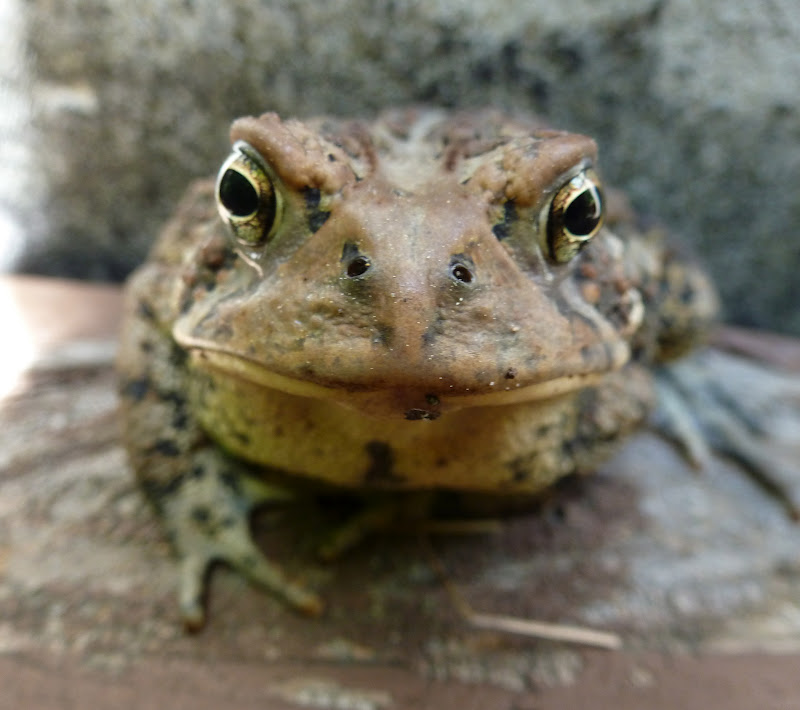
the day started out like any other day—phone calls, emails, dirty dishes, weedy flower beds, a dog patiently waiting to be fed—but then it turned, veered in a different direction, and left me face to face with the biggest, grandaddy-est eastern american toad i have ever seen. his (?) body length alone—i measured—was nearly four inches and—oh my—did he have fantastic bumps and warts. i was curious as to which bumps were warts and which bumps were, well, just bumps. his skin was dry and densely patterned with them, sprinkled with wonderful camouflage—an assortment of raised, large, small, brown, white, and black dots. to my mind he was indeed a splendid piece of living art. (after a quickie consultation with google i still do not have a definitive answer about how one identifies a genuine wart from that imposter, the generic bump.)


crouched low against the foundation in corner of the deck beside a planter (a large circle cut out of the decking into which a three foot deep concrete cylinder was inserted, ending up a few inches below the level of the deck and filled with soil, compost and flowers) this cute toad sat motionless, even with me leaning down and thrusting a camera in his face. 

i confess i have left the planter somewhat overgrown but, as it turns out, this neglect was a good thing because it probably provided a nice habitat for him—and who knows who else—and since i rarely remove the dead leaves and stalks from the container, but merely cut them up and leave them to rot into mulch, he may have hidden out in there for years.  

in this warm, dry, sheltered spot, the toad sat absolutely still. he blended in well with the patch of chipping paint between the edge of the planter and the house, but he wasn't moving at all. i wondered, was the chubby guy okay? suddenly i experienced a slight panic as i tried to recall where and when the exterminator had sprayed the foundation to get rid of carpenter ants. i don't normally use chemicals anywhere and it makes me cringe when an ant infestation necessitates the use of pesticides. i held my breath as i stroked him gently on his side with my finger. he blinked and turned his head. i withdrew my finger and exhaled—phew, thankfully he was alive and well.

judging by his size, the toad was old—old for a toad anyway—and to have reached such a grand old age i guessed that, in addition to requiring a place to call home, he must also eat rather well. i picked him up and held him on the palm of my hand. i stared into his golden and black jewel-like eyes for a moment and then gently placed him back on the deck. a tasty supply of mouth-watering spiders, moths, centipedes, flies, worms, and slugs reside in and around the planter, allowing the residents of the area to become fat and content.

i studied the patch of skin where the toad had sat on the palm of my hand. did it feel itchy or tingly or irritated? did i notice anything odd? no—there was no evidence of warts or bumps or anything sprouting on my palm. what is it about toads and warts? why the loathing, the fear? i don't pretend to understand a toad's skin, the purpose of it, and yet there must be a purpose, a reason, besides the obvious one, for it to have developed the way it has. i don't find a toad's flesh at all revolting—in fact, i like it. ah, but there is humor at work here, humor, as well as practicality, built into those bumps, into the very workings of the cosmos, is there not?

why are some people utterly freaked out by warts on toads, convinced there is a connection between a toad's lovely warts and the icky kind people get? toads do occasionally secrete a mild toxin which may cause minor skin irritation—but never warts—in some people, and of course we know getting warts from toads and frogs is an old wives tale. and yet, toads, and toad warts, still remain unpleasant for a lot of people to look at. we view them as disgusting; they make us uncomfortable.

there it is: humans are frequently made upset, uncomfortable and uneasy by what is harmless, inconsequential, and unimportant to this existence.

i imagined that beautiful old toad sizing me up, getting a good look at me while i was getting a good look at him. would he be critical of me—turn his head away in disgust—if i had a piece of spinach lodged between my teeth, or if he saw a fleck of mascara smeared under my eye, or discerned a small, hardly noticeable, pimple on my forehead?


Friday, July 20, 2012

four fourteen


so this is it, this is what it feels like to be the male of the species, a male who's about to become a father. this is what it's like to be standing on the other side, to be on the outside looking in, watching the person you love pass through a range of stages and emotions—bored, uncomfortable, in incredible pain, distracted, apprehensive, jubilant, impatient—not being able to do much to help, and feeling somewhat invisible, useless, helpless.

a few words—kind, soothing words, softly spoken, mixed with a little humor—that's pretty much it in my bag of tricks, although i suppose that's better than nothing. after all, in the "old days", days not very long ago, i wouldn't even have been allowed this, to be here in the labor/delivery room touching my daughter's shoulder, her head, her hair, trying to come up with the right words to say.

earlier in the day—nine hours earlier, to be exact.....

i hear a ringing sound. ringing—is it that, or is it something else?

my sleep remains heavy and undisturbed on this night and into the early morning hours, the sleep of the dead, as they say. far, far in the distance i hear bells; no it's music—that's it, music, not bells—almost inaudible violins playing beside a river, and the sound is traveling along the water toward me. or is it the sound of guitars, both sad and sweet, that i hear? no, i was right the first time. they are bells, cathedral bells, high above this ancient city built with many hands and heavy sweat and ancient stones.

i stir. sleep lifts. i begin to come out from under muffled slumber and dreams. i realize it's not bells, it's the phone that's ringing, brrrring-brrrring-ing in my head. i have been waiting for this call for what seems like forever—twenty months plus another nine—since the beginning of failed effort, and then when the words infertility and IVF—harbingers of both horror and hope—were introduced, and IVF was considered and tried, failed, and was eventually successful.

when the call comes i am unprepared. i have been prepared for weeks, ready for the call, but now, on this morning when it finally comes, i happen to be in the deepest of sleeps. i am disoriented in my drug-like slumber. why is the phone ringing at such an odd hour? my fingers blindly claw at the table beside my bed. at first i can't find it; when i finally do, the numbers on the dated (translation: ugly—it really should be tossed), 1980's general electric, brown plastic clock/radio/phone shine a bright and cheery four fourteen at me. then i hear her tired, happy, slightly quavering voice. mom, we're at the hospital. my water broke at 1 a.m..... and i wish i had wings and could fly to burlington to be at her side this instant. i am still groggy when i say we'll be on the highway by eight and hang up the phone. but, suddenly, i am wide awake. for me, the world is going to be different from today onward. i am going to be a grandmother.

the drive to vermont feels endless. when we're within a half hour of our destination we have to stop to let alex and kevin's dog, montana, out for a pee, and fill up her food and water dishes before we can continue on our way to the hospital.

and here we are. after many hours of keeping alex company, three of us must leave the labor/delivery room with the bird's eye view of lake champlain—it's time for her to start pushing her baby out. we try to wait patiently. i feel abandoned, left out—once again, male-ish—like fathers must have felt until about 40 years ago when they were finally allowed into the inner sanctum of blood and pain and joy. i wait, staring at the old-fashioned wall clock, watching the second hand's annoyingly perfect round and round promenade, for this most modern of fathers to walk through the door of the waiting room—once he has cut the umbilical cord and done some bonding—and announce the birth of his baby. (i have honestly never glanced up at a clock or at a door so many times in my life.) it will be near sunset when the waiting is over.

i marvel. the tiniest humans, the newest arrivals on this planet, carry with them such small parts—miniature orifices, appendages and limbs—parts that have never before felt the earth's warm air, or their mother's or father's touch. their noses have never smelled this world or any world, nor have their tongues tasted warm mother's milk. their eyes have only known darkness, their ears only muffled vibrations.

in the morning light his eyes open and he gazes at his mother as she holds him in arms that have ached for him. i try to handle my emotions. i blink away tears and blow my nose. i am convinced his infant stare is deep and knowing, like that of an old, old soul. but, of course, that cannot be. that's impossible.

an old soul in a new body. why impossible? maybe it's not such a far-fetched idea. within even the tiniest of newborn babies, under the soft, delicate, brand-new skin, lies the ancient, the unknown, the unfathomable, some small inkling of what we are, where we come from, how we have come to be. hidden inside each infant is a kind of universe, the hint of a thing that is old, very old—the origin of us all—and also a foretelling of what has never been seen, but, in time, may be.

every baby is a beginning, but he also contains the possibility of beginnings—the possibility of life for the next generation—inside him. he is who he is, but he is also the past and the future combined into one. as he journeys into his new world, he brings with him an unbroken link to an old world—those souls in his line who existed before—and an extension into the future, to those who will exist in a time far off, a time which has not yet even been imagined.

welcome, my little boy. welcome.


Friday, July 13, 2012

retreat


this day is a maine day—an achingly perfect maine day. if perfection is a thing that's possible, that's achievable, if—at least to some small degree—it is, then this is it, this is as close as it gets. on a day like this day, the sun is always shining and the wind is always blowing a steady beat, but softly, gently. each breath of air is sweet and deep and never enough. sails are full, lives are full.

no tourist mobs on this day, but i do hear faint, indiscernible chatter that sounds like the steady rasping call of an unidentifiable shorebird insistently seeking its mate from across the water. in reality it is only cap'n fish's tour guide, chattering on and on about local facts and fictions as the boat cruise winds down and the small vessel returns to pier 1 in boothbay.

on a day like this day it is easy for me to withdraw into sounds and sensations, to be alone with my thoughts even while in the company of other people. i do that; i retreat sometimes. i am not ignoring the friends i am with—i explore, walk over the rocks, admire the rugosa roses, laugh with these danes on holiday, take some pictures, drink some wine, show them how to get at the meat of the very first lobster they've ever tasted—i am a part of the ongoing conversation, but i am also in my own world. i can do that, and i like it there.

retreating into a small interior oasis of being doesn't cause me to become oblivious to the things around me. quite the opposite—i am actually much more keenly aware of everything. how is that possible? i don't know. maybe it is because i am deliberately focusing on the small details of what is oftentimes overlooked—layers of bark on a tree, a lone lobster buoy bobbing near the shore, sharp mountain pine needle tips, a jagged crack in granite—that seizing the big obvious parts takes less effort.

before we meet up with the people we have come to see, we drive along the water where the road hugs the rocky shore. we pull over and go out on the rocks for a few minutes. the tide is coming in. there are no signs to warn me that this is private property because it is not. this land was made for all of us to enjoy—a window on the water for everyone. on the other side of the road the big houses stand tall and proud, with broad porches, gray, salt-weathered shingles, bright white trim, and thick velvety lawns that lead down to the winding road. these homes, like so many others with million dollar views of the coast, are occupied a mere few weeks in the summer and are not rented out. they are private, period. i think to myself, if i owned one of these i would lose myself upon the shore. no one would be able to find me.

we drive on. further along the narrow street there is an aptly named place called retreat; it's more to my liking—not a big house but a cozy bungalow—but the address, 55 grand view avenue, strikes me as inaccurate. it doesn't fit. the road is more of a curving lane than an avenue, and the view is lovely, but this is maine and i don't think grand sums it up the way it should be summed up. grand is the wrong adjective; it sounds too puffed-up. like an overused sobriquet, how many grands and greats can there be—roads and islands and towns and lakes (although i'm sure the folks in the big houses think grand is just fine)—in the state of maine? what is truly grand, what deserves to be called this? something rich in detail and scope, vast, mind-boggling on an almost unimaginable level. someplace like the grand canyon is aptly named; it is truly grand.

i decide to take a peek; i walk closer toward the little hideaway. the tiny building—gray, modest, plain—sits directly on the water. this bungalow, hidden on the ledges under the pines facing the water's edge where the sun sparkles and gems ride the waves, where rugosa roses and mountain pine shrubs thrive in the salt spray, is exquisitely simple. the view, although breathtaking, and painfully beautiful, is not grand. grand is for people from away—technically, i am one of those, not having been born on maine soil, but i believe i have the heart of a real mainer—but not for mainers. true maine is a land of hardy, gruff, sea-faring and farming folk and skilled artisans and crafts people, people who make their living from what the earth has to offer.

old maine, the genuine article, the highly sought after original, is a place of simple, natural pleasures. it is not lofty and full of itself. it is salt water, seagulls, spruce trees, lakes, rivers, mountains, fields, silence. but change is already here; it has been for a long time, and more is on the way. and yet, if you look hard enough you may be able to find a small piece of what came before, of what once was—and what still can be—the pleasurable lure of retreat in the real maine.


Monday, July 9, 2012

an apology to vespula vulgaris


people have their own methods for handling stress—methods that perhaps aren't so much methods as they are involuntary brain responses, the old autonomic nervous system kicking in and doing its job—for determining whether a situation calls for an actual, all-out state of emergency, meaning panic mode has been activated, or not, and figuring out how they will deal with it. it may not be a newsworthy type of emergency, or one that requires lengthy telephone consultations or a trip to the doctor, or the kind that necessitates pressing 911, but it could be an emergency that is little, so little, in fact, that it escapes the notice of most people, but certainly not those for whom it requires immediate attention.

"oh my god, please hurry up! it's huge!" she yells from upstairs.

i don't know exactly when i became the go-to person for this particular kind of little emergency—it was certainly a long time ago—but i know that since i became that person i have had the joy of experiencing many intimate eye to eye and nose to nose moments with several species of buzzing and scampering bugs. i don't bother asking myself why me? because i already know why me.

oftentimes i am the only person—and that's including when there are males of our species on the scene—who will not flinch and just get on with the dirty business. whether it's in my own home, or the home of someone else, if there's a scuttling spider or a flying thing with a stinger coming out of its rear end (or, more accurately, its abdomen) i'm the one who is called upon to remove the intruder.

flying insects, spiders, beetles, centipedes, worms, slugs, ants, and other creepy crawlies don't bother me—they never have. (but i don't like lyme-disease-carrying deer ticks, and i especially don't like nasty black earwigs, with their scary looking curved pincers, that you sometimes see in drains or cellars; you know, those bugs that crawl in you ear, bore through your brain and lay a pile of eggs in there.*)

when the need arises—when errant bugs stray into the house—i am viewed as a kind of insect executioner, although, if i can avoid it, i generally don't execute bugs—i don't believe in execution—i merely relocate the offender.

the time has come. i am being summoned.

"it's in there," she says with a shaky voice, pointing an unsteady finger at the closed bathroom door. (this time it's hannah with insect issues, but it could just as easily have been alex or christina, or my mother-in-law, who is deathly afraid of spiders because she has always maintained she is severely—that's severely—allergic to their venom. i dare anyone to try telling her there are no venomous spiders anywhere near here.)

i am prepared. i have armed myself with a jar and a good, solid, just-in-case paperback.

then it's over. afterwards, i feel a little sad.

i was impatient. i was frustrated. i acted too quickly. i couldn't scoop vespula into the jar, and my attempts to capture the wasp were making it nervous, thus making me nervous (i don't mind bugs, but, like everyone else, i don't look forward to being stung.) i should have removed the screen where the wasp was focusing on its struggle, zigging and zagging and aiming for the light, only trying to get free, only trying to live. (wasps are, after all, beneficial to the environment, and are a welcome predator because they prey upon so many insect pest populations.) i should simply have let it out into the garden.

it's too late for should have, though, because i didn't.

*according to hollywood and nobody else


Friday, June 29, 2012

you're gonna rise up singing


Summertime, and the livin' is easy, fish are jumpin' and the cotton is high.....one of these mornings you're gonna rise up singing, then you'll spread your wings and you'll take to the sky.  —Summertime from the Gershwins' Porgy and Bess, lyrics by DuBose Heyward.


midnight wind, a howling and demanding wind, sucked air and tent fabric in, and then, in giant bursts, expelled them again, displacing oxygen like the lungs of a colossus, or a bellows of cosmic proportions. this was no weakling storm lashing at us during the height of summertime on a beach on prince edward island.


we were camping in the dunes on a lonely stretch of that lovely island in the late 80's, a thing unheard of in the united states due to strict dune preservation measures and laws to protect piping plovers and other birds nesting in the sand (probably isn't allowed in canada anymore, either) when a mighty gale and torrential rain blew in and pulled several of our tent pegs and poles out of the sand, toppling one side of the tent. needless to say, we survived in the tent (but of course in the tent....we would never abandon our campsite and head for the nearest hotel, well, not on that camping trip anyway), and the kids had great tales to tell when they got back to school.

a beach made of sand or pebbles or a bold rocky shore or any up close and personal view of the sea—doesn't matter where it is as long as it's not mobbed—i'd travel a distance to find a sea view like that.

where you'll find me in the summertime—where i'd like to find myself—could be the wild and blustery shore of embleton beach in northumberland in the north of england (where the signs on the motorway pointing you in a northerly direction actually say THE NORTH, and going south it's THE SOUTH). the huge, imposing, romantic ruins of dunstanburgh castle (this ground felt the likes of john of gaunt, and the wars of the roses) in the distance beyond the golf course didn't look that far, but as i walked on the beach i realized they were farther away than i thought. that walk was a long time ago, way back in 2004; i have every intention of walking there again.

or it could be on fox island, a hill of granite ledges and boulders—and not much else—deposited by glaciers, only accessible at low tide in phippsburg, maine. climbing and poking around up there is an annual thing i like to do to mark and celebrate the arrival—the essence—of summer. the rocks, wearing skirts of sticky seaweed, periwinkles and barnacles, show off exposed backs and arms and thighs tattooed with colorful lichens.

seagulls do a lot of screaming, and they'll steal your picnic lunch—i've even seen them tugging on tote bag and backpack zippers—if you don't watch out. have to keep an eye on the tide, too; it looks harmless but it's not. i leave enough time to get back when the tide turns, and i stay on the sandbar. a tempting shortcut beckons through the water, yet even for a strong swimmer who doesn't mind cold water, it is not recommended since the swirling waves can pull you under and away. if fog rolls in, foghorns—like the one at seguin island and another one at pond island—are some of my favorite sounds of summer—eerie and forlorn, but wonderful, if you like that kind of thing.

remembered beaches—crane, plum island, embleton, jasper, reef bay, singing sands, goose cove, sea glass, crescent, reid, kitty hawk, higgins, pink, seawall, tarpon bay, popham, gulfside, bamburgh—and all the beaches in between with names i can no longer recall; names forgotten, adrift, blown away as if by a distant sea breeze, but to whose shores i will always return in the sweet lullaby of memory, smiling and singing a little song of summer.

~ photo of the dunstanburgh castle ruins by ed montalvo.

Tuesday, June 26, 2012

snip, snip, gather them in


last week.....

the first day of summer. ninety degrees and steamy at eleven o'clock in the morning. not a typical maine day, no, not at all. joe cupo on channel 6 predicts three more days of this. i stand in the garden, glance around, shake my head. in addition to the heat, there's something else that's not quite right, something else that's off.

silence. dead silence. not a chirp, not a song, no buzzing of bees or dragonflies or the low hum of an incoming hummingbird over my head, no wind, only the faint burble of the little stream as it meekly shushes and tumbles, seeking its way through the forest.

i stare at them. they are starting to appear defeated, heads drooping low. i know if i don't take some action many of the splendid buds won't bloom properly, and those that do won't last. they will be seared and cooked right on their own stems until they're well done and finished. i mutter to myself this isn't good, not good at all.


it's too much for them. (it's too much for me. i don't know how i would deal with the heat if i lived in the south. james and megan won't see me visiting them in texas in the summer, that's for sure.) they will wilt, wither, waste away, if left alone to fend for themselves against the heat wave that's overpowering everything, myself included. but there's one thing i can do to save them—get the scissors and start cutting.


we don't get a lot of oppressive days like this along the southern maine coast—maybe 3 or 4 of them a year—and by oppressive i mean where there is no reprieve from the heat, no afternoon sea breeze, the humidity staying high and the temperature barely dipping and there's nothing to help air out the house and cool it down in preparation for yet another day of heat. we used to tough it out when there wasn't a breeze—we didn't even have an air conditioner in the bedroom until two years ago—but we've become wimpy. no, not we, me. i'm the wimpy one; ed doesn't mind the heat.

i grab an old pair of slightly rusty scissors i use for the garden out of a terra cotta pot on the porch where i also keep the garden trowels and some string. snip, snip, gather them in before they fall to ruin. i whisper to them, to myself, in reassuring tones, fill the basket, carry them into the cool house and put them in fresh water away from the sun. i have closed the shades and curtains—it is as cool and dark as a crypt. i don't like it; i would much rather be able to leave the shades open and live in the light.

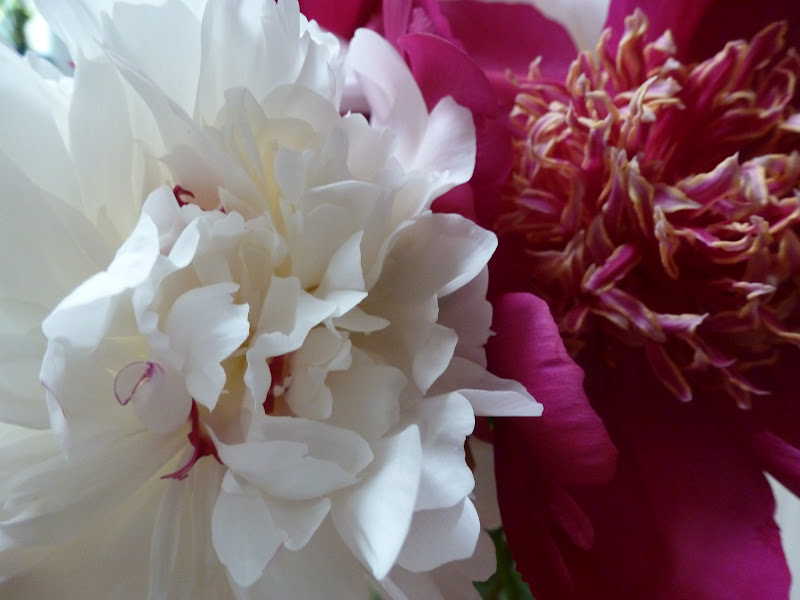
the silky, multi-layered white flowers, with bits of deep pink hidden like little surprises inside their frilly ruffles, are my favorites. they smell particularly sweet—they make the whole room smell sweet. i don't remember its name, but that plant is my most prolific. i am having some trouble with the raspberry/fuchsia/magenta/rose ones—what color are they exactly? i get confused, almost color-blinded by all the names—way too many shades of pink—which are bush-like and exhibit fine green leaves but not many blooms. do they need more manure? more mulch? more love?

the name—peony. i like saying it even if it's just in my head.


what do meteorologists know. the next day a cold front from the north lands on our doorstep and brings with it some clouds and a breeze, and much lower humidity and temperatures. comfortable. shades up, windows open. (we are, as they say, on the leading edge of the front. just 25 miles south of here, and a few miles to the west, it's still sweltering.) my snipping was completely unnecessary; i could have left the peonies alone. but never mind—they keep me company indoors instead, where i see them both night and day.

this week.....

the inevitable falling of petals, the bottommost ones heart-shaped and crumpled and lying in a heap.

Friday, June 22, 2012

her art of another kind

Hannah Montalvo, Diary, 2012 (detail). Mixed Media on Board, 60 x 52 x 1 1/4 inches.

...the revitalization of experimental art following WWII signified a renewed interest in freedom of expression, spontaneity, and unorthodox materials—un art autre (art of another kind)—a radical break with all traditional notions of order and composition in a movement toward something wholly "other."  —Excerpt from the exhibition catalogue for Art of Another Kind, International Abstraction and the Guggenheim, 1949−1960. On view at the Guggenheim until Sept. 12, 2012.


my journey home two weeks ago began under sunny skies in vermont with me crossing my fingers and hoping that the day would stay dry, at least until i could get hannah's painting safely back to maine. (major thunderstorms were in the forecast for the afternoon.) the painting was too big to fit anywhere except in the back of the pickup truck so.... hannah and a friend carefully loaded it, wrapped it in a blue plastic tarp and strapped it down with bungie cords. i was now on my own—hannah would remain in vermont for most of the summer—and i had the responsibility of transporting my daughter's artwork home intact.

within an hour of unpacking her work and getting it in the garage, dark clouds brought thunder and lightning and rain which continued, on and off, for the rest of the afternoon.

last saturday ed and i hung the large abstract* painting. it took a few hours, including the time ed needed to locate, purchase, and attach the proper bracket hooks on the painting's frame and on the wall in order to mount and securely hold the 40 pounder on the only spot in the house where it would fit—the wall halfway up the staircase to the second floor.

i'm glad this piece from our girl's semester of work is with us. i joked with hannah that i should place candles and flowers under this painting, and some of her others also located in the upper hall, as a kind of shrine dedicated to her since she—and her creative spirit—dominate that space.

of course, the idea of candles and flowers and shrines was just meant to be funny, but the idea of a place where her creative spirit resides when she is not physically present is no joke.

she is with us.

within the combination and manipulation and transformation of basic materials—wood, paper, canvas, fabric, ink, paint—is inhabited space. her creative energy lives up there.


*some people call abstract art weird. sometimes they don't understand. sometimes it's hard to understand. some people say abstract art is disconnected from reality. that's true, if by disconnected from reality we mean it doesn't represent external reality, it isn't a replica of the obvious, of what we capture with our eyes, or the way a camera lens "sees." but there is more to reality than this. not all reality is beheld with our eyes, not all reality is witnessed externally. abstract art is disconnected from reality as we see it, but certainly not as we know it and discern it inside of ourselves.

Tuesday, June 19, 2012

the scent of the night stalks

 along the caloosahatchee river. florida. january, 2012.


windows, thrown wide open to receive the warm, breezy, new air of daytime, need to be closed before bed. it is turning chilly, a real maine evening, one of those evenings where sitting in an adirondack chair around the campfire in the backyard—zipped in a sweatshirt, feet stretched toward the flames—is a good thing, but once you're inside, the night needs to be shut out.

as i reach for the handle to crank the window i pause. a sweet smell lingers on the nightair, a scent heady as incense—though more subtle—not a scent that can be described or identified as one particular plant.

forget-me-not. fiddlehead fern. chive. columbine. lily. euonymus. dandelion. azalea. peony. vinca. lilac. phlox. meadowsweet. grass. oregano. iris. hosta. countless weeds.

i stand motionless. i inhale. it is none of these—and yet it is all of these.

the aroma originates below, in the darkness of the underground world—not only in my yard, but everywhere—each place with its own particular scent, sometimes pronounced, sometimes not. the scent comes from the night work of plants. a pervading smell—a heavenly smell—of what, i cannot be sure, of what, i cannot say, but it strikes me that it is like a clear, rippling liquid, so i will call it a night juice: the juice that rises up.

i breathe it in. night essence.

it begins its move beneath the surface as the rainwater that washes over everything is gratefully accepted by earth and roots. the roots drink and it slowly starts the ascent, the vertical suck, streaming into stems and stalks after the roots have done their work, the lifting of the juice as it continues to make its way into the tips of quivering leaves and blades—long and narrow, round and full, small and compact, shiny and pointed, slivers, a multitude—and then out onto the air.

in the silent evening the earth stirs with that restless climb of fluid and nutrients—with life itself—and brings its perfume to my nostrils. i remove the screen (damn the mosquitoes, but then without them the bats and wrens and phoebes would not be satisfied) and stick my head out, hovering by the window a moment longer to drink in the sweet flow, this mighty night therapy, and its ability to calm and soothe after a long day.

i savor it—the heaviness, the dark rush, the pulsing up. the evening, alive.

i pop the screen back in place, lock the window tight. i climb into bed.

Friday, June 15, 2012

magnetic


she watches NOVA, he watches football. she prefers tea, he prefers coffee. she is short and blonde, he is tall and dark. she sighs over red sunsets, he sighs over red ink. she loves modern art, he loves vintage cars. she takes note of new flowers, he takes note of new technology. she makes friends easily, he makes friends cautiously. she likes the heft and smell of a real book, he likes the [nonexistent] heft and smell of a kindle. she makes plans in advance, he makes plans at the last minute.

she thinks the weather is perfect for working out in the yard, he thinks the weather is perfect for working out at the gym. she is thrilled by incredible words—how about rosanna warren's from new hampshire—he is thrilled by incredible numbers. she stares at her books, he stares at his iphone. she's messy and leaves clothes and papers heaped in piles, he's tidy and never leaves clothes and papers heaped in piles. she was raised a fresh-air-and-forest country girl, he was raised a smog-and-pavement city boy.

but when all is said and done, they are both at home, sitting beside each other in the evening, two opposites attracting.

Tuesday, June 12, 2012

cracked


last may i was in massachusetts at the house on the hill where my parents live. the house is situated above what i like to call our golden pond—that's beck pond on a map—the place where i grew up and still, to some extent, consider home.

the weather was pleasant and sunny but not yet warm enough for swimming. my dad, a fit and healthy eighty year-old, was busy preparing lunch while i visited with my mother. over the last few years my mother's health has been steadily deteriorating, slowly diminishing under the silently prowling brain thief that is alzheimer's disease. speech is cumbersome for her—her ability to express even the simplest of thoughts is disappearing, and the few words she does manage to say are arrived at only after a great struggle. but on that day we were, in our own figure-it-out-as-we-go-along fashion, "conversing", with me holding her hand and guessing—do you mean this, mom? or this? no? how about this?—and filling in her blanks, trying to get the answers right like i was taking a bizarre multiple choice exam.

after lunch, my father and i made my mother comfortable on a chaise lounge on the patio overlooking the pond—she walks with difficulty and staircases are treacherous for her—and went down the stairs to the water, with my mother in our sight the whole time. we came back up and walked by the vegetable garden, checked to see if my mother needed anything, and continued around the other side of the house past my parents' beautiful stonewalls and up a long stone staircase—all built by my father (my mother helped) using stones they found on their property. (when you need rocks for a landscaping project it helps to live in new england where backyards can be full of them.)

it was then that my father pointed out the nest.

a large robin's nest filled with four gorgeously blue eggs.

but it struck me that something was wrong, horribly wrong.

i couldn't believe what i saw.

why—oh tell me why?—would a bird build its nest on the ground? i've seen nests built quite low in trees and bushes, but never on the ground, and this one was next to the foundation with no bushes or plants or anything to camouflage it, no protection whatsoever from predators.

when i looked at that nest, so utterly, hopelessly, exposed in a corner by the chimney, i was overcome with sadness, a deeper sadness than the situation called for. after all, birds and animals die all the time—nature is cruel, nature is unsympathetic. that's life. those are the facts. i knew that, knew it well. i thought get a grip; get over it. but in that moment i couldn't. i was hit hard by what i believed was the nonexistent future of the tiny lives contained within those shells; i was overcome by inexplicable and somewhat irrational emotion. i just wanted to be able to do something to fix things, to make things right, and yet there was absolutely nothing i could do, no way to change the outcome fate had in store for the baby birds.

a few weeks passed. one day i was on the phone with my father and suddenly i thought of the robin's eggs. i asked him if, by some miracle, the babies had hatched without incident. of course, i already knew the answer, but i waited for him to tell me exactly what happened.

there was not much to tell—events unfolded quickly. turns out, it didn't take long for what some people might call a bad luck disaster, and others might call a good luck opportunity—depending on whose side you're on—to come skulking along. the possibility of life for those unhatched-lings, which had been in doubt from the start, was like a dream—like something longed for, hoped for—with the dream coming to an abrupt end about a week after i left massachusetts. when hungry bellies demand sustenance and the brain yells go find food, what choice does any creature have?

my father informed me that the interior of the nest was in shambles—of the four eggs only three were left, and those were cracked wide open, their warm, wet interiors sucked dry, signaling fullness and contentment for a crow or a bluejay, a raccoon or a skunk. (he never did find the remains of the fourth egg.) not such a tragic situation, really—lives given up so other lives could manage to make it through another day. that's the way it goes.

i felt nothing after he told me the news—my emotional overdrive had been spent when i saw the nest.

actually, that's inaccurate. i no longer felt emotion for the ransacked nest, but i did experience an emotional response after i hung up the phone. i thought about my mother. it occurred to me that she had no idea about what had happened, no idea how events played themselves out after the nest's discovery. the story of the nest and its contents remained with her for a short time and then was lost—it became part of the realm of mystery—unless she was reminded of its existence.

in her world, facts such as these don't matter—they are completely useless to her. the facts remain for me and my father to decipher—we alone can break into them and get at them, allowing them to signal the beginning of another chunk of time, another chunk of reality different than hers, one where life has a before and after. we've become sharply aware of our own lives: it's as if we're in a kind of passage and, in order for us to avoid losing our way in this brittle existence, we need to know where we've been to help us figure out where we're going.

~  i took the photo of the nest on the day i saw it last year. my father was kind enough to save it for me after it was raided so now it's one of the nests i put on the christmas tree every year. the nest reminds me of a year of changes, and it always leads me to bittersweet thoughts of my mother.


Saturday, June 9, 2012

this missive: pulverized scabs


when abigail got down on her knees with her head bowed low, it could easily have been assumed—given the circumstances—that she was about to pray, that she was yet another whispering supplicant begging for a merciful god to save her children from a deadly epidemic. but the fact of the matter was she was on her knees searching—the praying would come later—bending over the floorboards muttering about the piece of thread she had inadvertently dropped—and the physician urgently needed—for the planned inoculation against smallpox in her boston household.

abigail adams made the decision in favor of inoculation on her own; her husband, john, was on a diplomatic mission overseas and already inoculated. besides, she knew he believed in its benefits. his wife was determined to take the risk of having herself and their four children deliberately infected in the hope of causing a mild case, rather than wait in fear for the disease to attack with its full fury.

by candlelight, after the children were tucked safely in bed, she inked pages and pages to john, unburdening her soul of doubts and fears and daily dramas, sometimes adding her dry humor or a quip about the shortages they suffered in 1776—god grant that we all may go comfortably thro the distemper, the phisick part is bad enough i know[....] a little india herb would have been mighty agreeable (suggesting john should place an order and get the damn tea home in a hurry)—until her hand ached and she put down her quill. her nights continued to be sleepless.

such a simple thing, and yet how frightening, this new medical procedure called inoculation: drag a piece of thread through the pulverized scabs and pus from the sores of an infected person, make a tiny incision in one who is healthy, and dip the bacteria-laden thread into it. done. wait for the arrival of pocks.

fat dispatches—paper covered with the sometimes blotchy markings of her dense script—held abigail's hopes and dreams and insecurities—and, at times, her deep loneliness and despair; they contained the passionate expression of her copious thoughts which ranged across the war and the children and the news of scabs and fever, but also other endless details from the management of her home and farm: the buying and selling of livestock, hiring help, construction projects, purchasing seed and equipment, planting and harvesting, drought and flood. details, details.

in past centuries, these missives were bound and sealed with wax and came to rest in the belly of a ship's wooden hull, sailing months upon the sea in the hopes of landing safely in europe or some other distant place.

i don't have a quill—but i have a keyboard. as i write i wonder what would abigail make of a keyboard? what would she think of my online missives—of all our online missives? would she think oh how i could have written! and exclaim oh, how wonderful! to have my thoughts and my news passed on fresh, not dreadfully outdated, by using this unimaginably timely mechanism, and to know that one's words will not be lost to the bottom of the sea but will be read and understood and that someone, hopefully, will find they matter and be glad to read them.

our words—the many, many viewpoints describing the funny, sad, reflective, exuberant, poignant, interesting, happy, thoughtful, crazy, introspective slices of our own lives—don't encounter the old dangers of mail delivery that awaited ships sailing on the high seas, or the perils pony express riders ran into crossing the great plains and the high sierra, or even the small problems of the modern day postman or UPS employee who must also brave weather and, occasionally, barking—and quite possibly biting—dogs.

in our century, words are mostly safe. in this, our unusual correspondence, the written tradition lives on and our "letters" journey free and easy, zinging across incredible distances through cyberspace where, in fact, there is no such thing as distance. instead of sinking or burning or being lost forever in a snowy mountain pass, our missives are transmitted instantaneously for the whole world to see. the snippets of our lives—the rendering of these astonishing pieces of minutiae, these bits of pulverized scabs—remain intact.

hit the orange rectangle and it's done.

you see? isn't that something? this missive—and yours, too—has already arrived.


Monday, June 4, 2012

dripdrop


dripdrop the weekend: in a word, rain. and more rain. nonstop rain. cold rain. isn't the weather what boring people end up discussing when they have nothing else to say, nothing better to talk about?

dripdrop saturday morning until mid-afternoon: hannah and i took care of amelia for a few hours while her mom had a photo shoot. when christina finished she brought jilly back with her and we enjoyed a really nice visit—so good to see you, jilly. how's it going with o's briefcase collection?—while we waited for the baby to wake up from her nap.

dripdrop late saturday afternoon: a little drama descended upon us in the form of an ominous phone call. hannah's summer roommate was at their apartment in vermont supposedly getting ready to move in and she called, distressed and in tears, to tell hannah (who was subletting from another student) that there were broken windows and rodent droppings and disgusting smells—the apartment was, in a word, uninhabitable. the landlord was indifferent to her roommate's pleas to do something about it. for hannah it was simply too late to negotiate; she needed to find another apartment posthaste since she was due back in vermont in five days to take a summer course and begin her job at the university as a teaching assistant in photography. hannah calmly told her roommate she was going to look for another place to live until mid-august when she returns home for two weeks before she heads out again for a semester abroad (london for a few days, then florence for a two-week orientation, then rome).

dripdrop quote of the day: thinking beyond these college days, hannah sighed and said "i need to get a real job. i need to start my life." (i don't know what, if not life, she has been living up to now.)

dripdrop saturday night: out for dinner and hannah's working the phone—apartment hunting in cyberspace—combing through craigslist and uvm's bulletin board in search of a place to call home in burlytown for the summer.

dripdrop sunday morning: road block ahead. the road was flooded one mile from the house. turn around and go the other way. breakfast at the freeport cafe with hannah, hannah's friend, molly, and molly's mom, vicki. good eggs.

dripdrop the rest of logy sunday: rain hitting the skylights and the rooftop like fingers tapping on a table that turns to rain hitting the skylights and the rooftop like a fist drumming on a table.

monday morning. no drama, just hot, black tea with a splash of milk and—ho hum, my dears—more rain, rain, rain.


Friday, June 1, 2012

hidden in the lady's house


whoosh. here's june.

my woodsy maine garden really begins to heat up in late spring. unfortunately, after many thunderstorms and torrential rain and kisses from the sun, the weeds are quickly outpacing me. i try to keep up—things look okay—just too bad the weeds will always be several steps ahead. it's a jungle out there, but—if you'll permit me to say so—it's a nice jungle.

bees, bats, butterflies, dragonflies and hummingbirds make the rounds. there's a welcome crowd—a busy, boisterous, hard-at-work crowd—amongst the shoots and blooms, swooping in and out and about the plantings, the buds, the leaves.

crazy overabundance, spilling over. that's what it is; that's what's visible.

but then there's the invisible.

those secret places. the inner sanctums. the private abodes. when male and female are together inside the soft, delicate folds of the petals. look closely—it's a steamy, x-rated place. love, green-style. seeds, birth, new generations.

take the azalea. look at her. what you see is no blushing bride, no shy innocent stigma. she is fiery and brazen, that one, and throws herself wantonly toward the sky to receive his pollen. what a delight.

below her stigma—near her middle, around the style—a ring of courtiers surrounds her (many male and female parts all in close proximity to one another—i would guess it's a good life for everyone playing inside this flower) each one a dusty anther where pollen is produced—the man's house, androecium.

a hidden place, unseen, lies below that. the gynoecium—the lady's house—with the ovaries, the eggs.

i don't need to tell you the details of what happens next, once the pollen grains travel down the style. they'll do their thing and not a single person will take notice. not a single one. it will simply be done.

and that's just one flower. how are your math skills? count, then multiply.

what can i say? i'm a hopeless romantic—there's no stopping love.

speaking of no stopping love—but in this case a bluesy kind of love mixed with some real rockin' love, too—last night ed, hannah, christina and i saw marc cohn and bonnie raitt in portland. she, like the name of her song, is something to talk about. man, can that lady perform. at 63 she's lookin' good and she's still got it in her—such a talented guitarist and singer. she and her band put on a fantastic and long—hand over mouth covering yawns this morning—show.